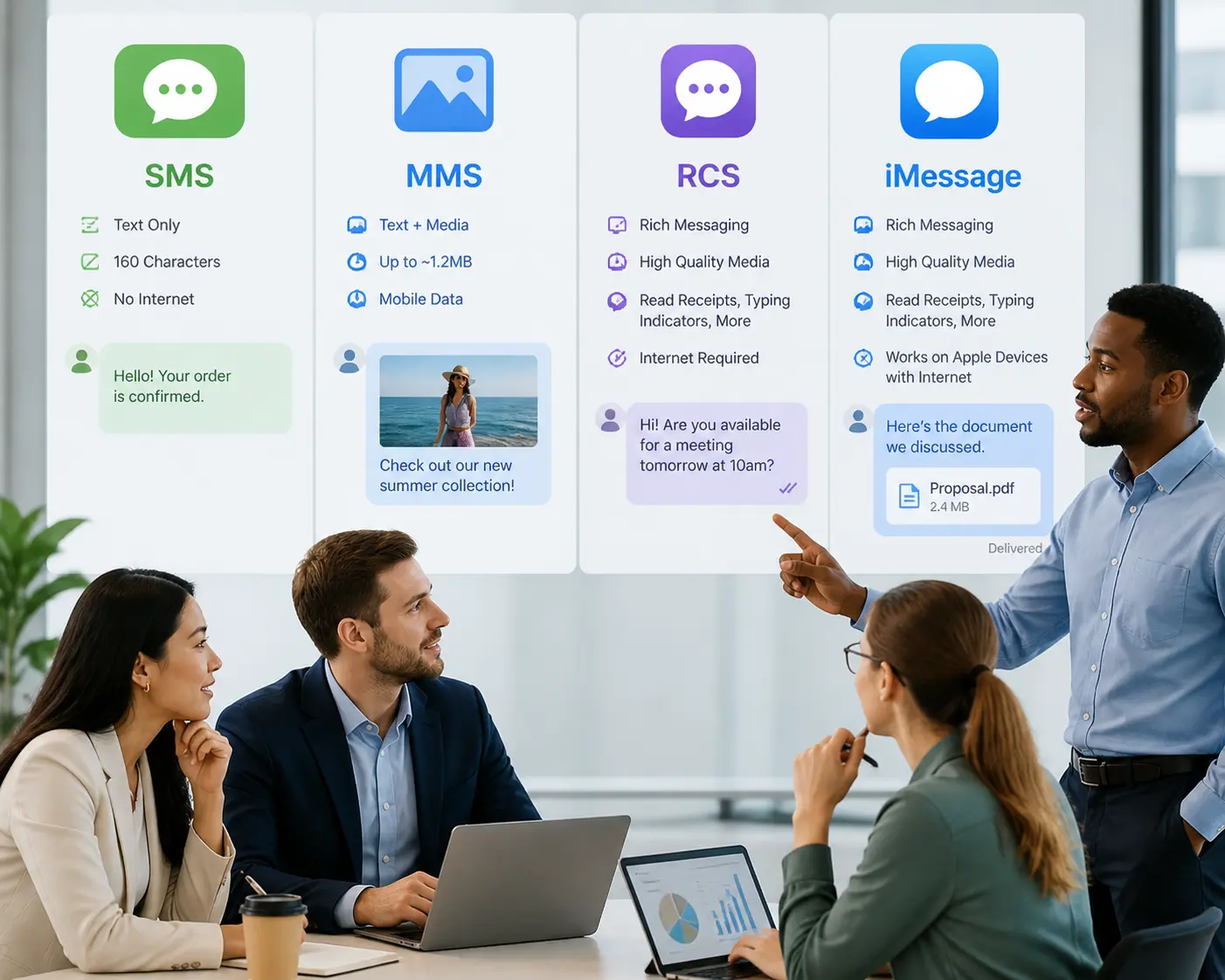
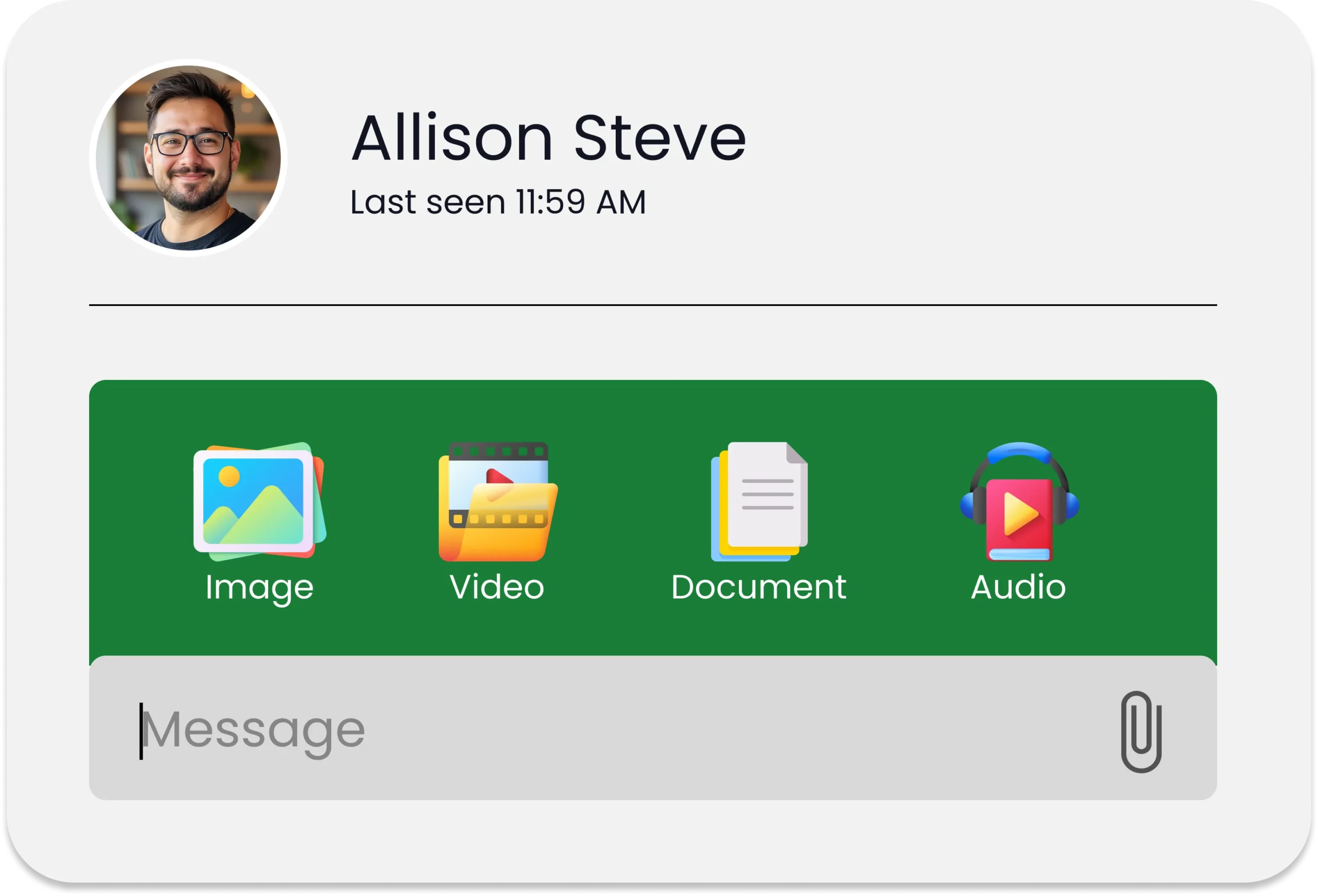
There are three types of text messages a US business can actually send: SMS, MMS, and RCS. SMS is plain text and costs the least. MMS carries images and video and costs more. RCS adds chat-style features but does not yet reach every phone.
The format is not something you pick in a settings menu. What you put in the message decides it, and that decision changes your bill. Attach one image to a text going out to 10,000 contacts and the carrier reclassifies the whole send as MMS.
This guide covers what each format sends, what each one costs, how to tell which one your own messages are using, and which one to build your program on.
Key Takeaways
- Mobile messages come in several types: SMS (text), MMS (media), RCS (rich), plus OTT app messages and push notifications.
- SMS works on any phone with no internet; MMS adds images and video; RCS adds app-like features on supported devices.
- For business, SMS and MMS give the widest reach and carrier-grade deliverability; RCS and OTT depend on device and app support.
- Choose the message type by reach, content (text vs media), and whether recipients are on supported devices.
The 3 Types of Text Messages
Every text your business sends goes out as one of three formats. What you put in the message and what the recipient’s phone supports decide which.
SMS (Short Message Service)
SMS is plain text, capped at 160 characters per segment. Go past the cap and carriers split the message into multiple segments and bill you for each one. No images, no formatting, no rich media. In exchange it reaches every mobile phone in service, including phones with no data connection and handsets fifteen years old.
Almost all business texting runs on SMS. Appointment reminders, delivery confirmations, verification codes, outage alerts, and two-way conversations with a real person on the other end are all SMS.
MMS (Multimedia Messaging Service)
MMS carries images, GIFs, video, and audio, and lifts the text limit to roughly 1,600 characters. It costs more per message than SMS because the carrier is moving a file rather than a line of text. Delivery is near universal but slower, and carriers compress large images, so the photo your customer sees is not the photo you uploaded.
Use MMS when seeing the thing is the point: a product shot, a menu, an event flyer, a coupon someone will screenshot at the counter.
RCS (Rich Communication Services)
RCS is the newer protocol that adds read receipts, typing indicators, verified sender branding, and tappable cards. It behaves more like a messaging app than a text message.
The catch is reach. RCS only works when both the sender and the recipient support it, so an RCS campaign still needs SMS underneath it to reach everyone on the list. Treat it as a layer on top of your program, not a replacement for it.
SMS vs MMS vs RCS: Full Comparison Table
| SMS | MMS | RCS | |
|---|---|---|---|
| What it sends | Text only | Images, video, audio, plus longer text | Rich cards, images, buttons, carousels |
| Character limit | 160 per segment | Around 1,600 | No practical limit |
| Cost per message | Lowest | [INSERT: SendHub per-MMS rate vs SMS] | Varies, generally above SMS |
| Who receives it | Every mobile phone in service | Nearly every phone | Only RCS-enabled devices |
| Read receipts | No | No | Yes |
| Sender branding | Number only | Number only | Verified name and logo |
| Best for | Reminders, alerts, two-way threads, verification codes | Product images, menus, coupons, event flyers | Rich experiences on top of an existing SMS program |
| Who it is wrong for | Anyone whose message needs an image to land. Text alone will not sell a product people need to see | Anyone sending high volume where the image is decoration. You pay several times more per send for no extra reply | Anyone who needs guaranteed delivery to every contact. Reach is still partial, so it cannot be your only channel |
SMS vs MMS: The Difference That Costs You Money
The practical difference between SMS and MMS is not features. It is billing.
SMS is the cheapest way to reach a phone. MMS costs more per message because the carrier is delivering a file. On a list of 10,000 contacts, choosing MMS when SMS would have done the job multiplies the cost of that campaign and usually earns you no extra replies.
The rule is simple. Send MMS when the image is what makes the customer act. Send SMS for everything else, which is most things. An appointment reminder does not need a photograph.
There is a second billing trap worth knowing, and it catches people who have never sent MMS in their life. SMS is capped at 160 characters per segment, not per message. A 400-character text is not one message, it is three, and you are billed for three. Tightening copy to fit a single segment is the cheapest saving available in business texting, and most teams have never checked.
If you are planning campaigns across both formats, our guide to SMS and MMS marketing covers how to budget for the mix.
Are Your Texts SMS or MMS? How to Tell
This trips people up constantly, so here is the short answer.
If your message is text only, it went as SMS. The moment you attach an image, a video, an audio clip, or run well past the character limit, the carrier converts it to MMS and bills it as MMS. You do not choose the format with a setting. The content of the message chooses it for you.
On an iPhone, a green bubble means the message went out as SMS or MMS through the carrier. A blue bubble is iMessage, which is Apple’s own service and not something a business texting platform sends through.
On Android, adding any attachment switches the message to MMS automatically. Group messages also frequently convert to MMS, which is why a group text can cost more than the same message sent to each person individually. If you are sending to a large list, mass texting sends individually rather than as a group thread, which keeps the format and the cost predictable.
What About RCS?
RCS is worth understanding but it is not a decision most businesses need to make yet. Delivery depends on both sender and recipient supporting it, so an RCS campaign still needs an SMS fallback to reach the full list. Treat it as an upgrade to the experience, not a replacement for the channel.
We cover the full comparison, including where RCS genuinely beats SMS in 2026 and where it does not, in RCS vs SMS.
What About iMessage?
iMessage is Apple’s own messaging service, not a business texting format. It works only between Apple devices, and businesses cannot send marketing or transactional campaigns through it from a texting platform.
If you are comparing formats for your business, iMessage is not on the list. It appears here only because people often mean iMessage when they say their messages “look different” on an iPhone. A message that arrives green went through the carrier as SMS or MMS. That is the format your business is actually paying for.
Which Type Should Your Business Use?
Start with SMS. It reaches every phone, costs the least, and handles the overwhelming majority of business use cases. If you are not sure, this is the answer.
Add MMS selectively, for the campaigns where the image is doing the selling. Keep it a deliberate choice rather than a default setting.
Watch RCS. It is not yet a channel you can rely on alone, but it is where rich business messaging is heading.
Two things sit alongside this decision and matter just as much.
The first is the number you send from. Shortcode, 10DLC, or toll-free changes your throughput, your setup time, and your cost, independently of which format you send. That is covered in our guide to the SMS code.
The second is consent. Whatever format you send, TCPA rules require prior express written consent before the first marketing message, and STOP requests must be processed immediately. See what opt-in means in text messaging.
For high-volume sending across either format, bulk SMS handles the throughput and keeps consent records attached to every send.
Frequently Asked Questions
SMS is text-only messaging limited to 160 characters per segment, while MMS supports images, video, audio, and up to 1,600 characters of text in a single message.
RCS offers read receipts, high-resolution media, interactive buttons, and verified sender profiles within the Android messaging app, with automatic SMS fallback when unsupported by the recipient.
Not through standard SMS platforms. Businesses must apply for and be approved through Apple Messages for Business, making it a restricted channel compared to SMS and MMS.
Apple introduced RCS in iOS 18 but full cross-platform capability is still expanding. For guaranteed delivery across all devices, SMS remains the most reliable universal fallback channel.
SMS reaches every mobile phone on every carrier globally without an internet connection, making it the format with the broadest guaranteed reach of all four protocols.
No. iMessage is internet-based and falls under Apple’s platform policies rather than TCPA. SMS, MMS, and RCS all require TCPA compliance including explicit opt-in consent and immediate opt-out processing.
For visual campaigns yes. MMS generates up to 3x higher engagement than text-only SMS, making it significantly more effective when images, GIFs, or video add genuine value to the message.