SMS customer service wins on structure, not on hype, and the structure is why it keeps taking volume from the phone queue and the shared mailbox. Americans exchanged nearly 2.2 trillion SMS and MMS messages in 2024, according to CTIA’s 2025 Annual Survey, so the channel is already where customers are. Salesforce Research reports that 82 percent of service professionals say customer expectations are higher than they used to be, and that 61 percent of customers would prefer to use self-service to resolve simple issues. Text sits precisely between full self-service and a live call. This guide covers where it beats each channel, where it does not, and the rules that govern it.
Where SMS Customer Service Beats the Phone
There is no queue. A customer sends a message and gets on with their day. Nobody waits on hold, and nobody abandons at four minutes because the wait became intolerable.
One agent handles several conversations. Voice is strictly one to one. Text is asynchronous, so a single representative can carry multiple threads without any customer feeling rushed.
The thread is the record. Order numbers, addresses, and agreed actions stay visible to both sides. Nobody repeats themselves after a transfer, and there is no dispute about what was said.
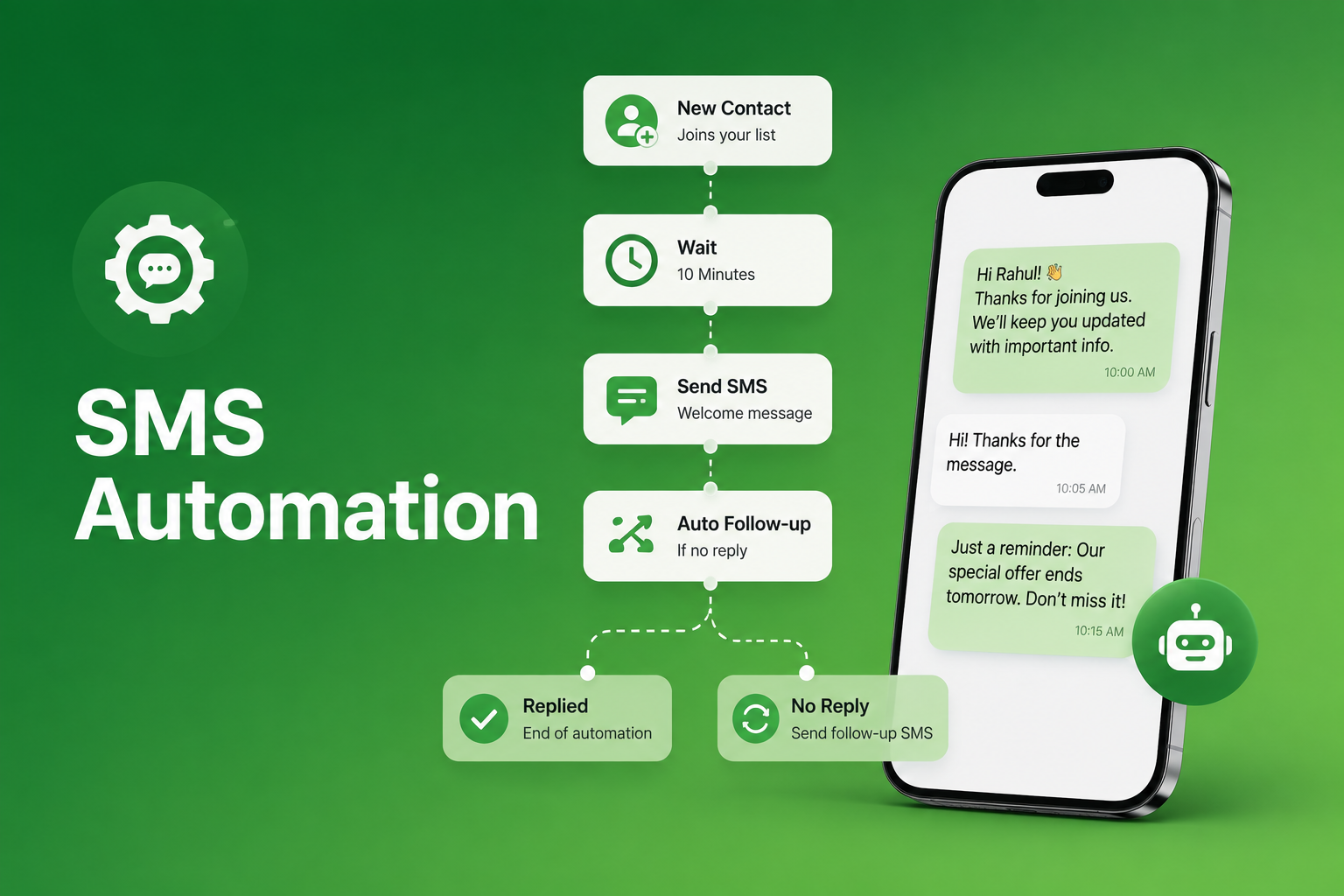
No menu tree stands in the way. Customers state their issue in their own words. Routing happens behind the scenes, which is where automation belongs in service workflows.
Escalation is one step, not a callback. A thread that needs a voice conversation becomes one immediately, and the written history goes with it. This is what separates two-way texting from broadcast messaging, because the reply path is designed rather than accidental.
Voice still resolves faster on genuinely complex problems. The advantage of text is that most support contacts are not complex.
Where SMS Customer Service Beats Email
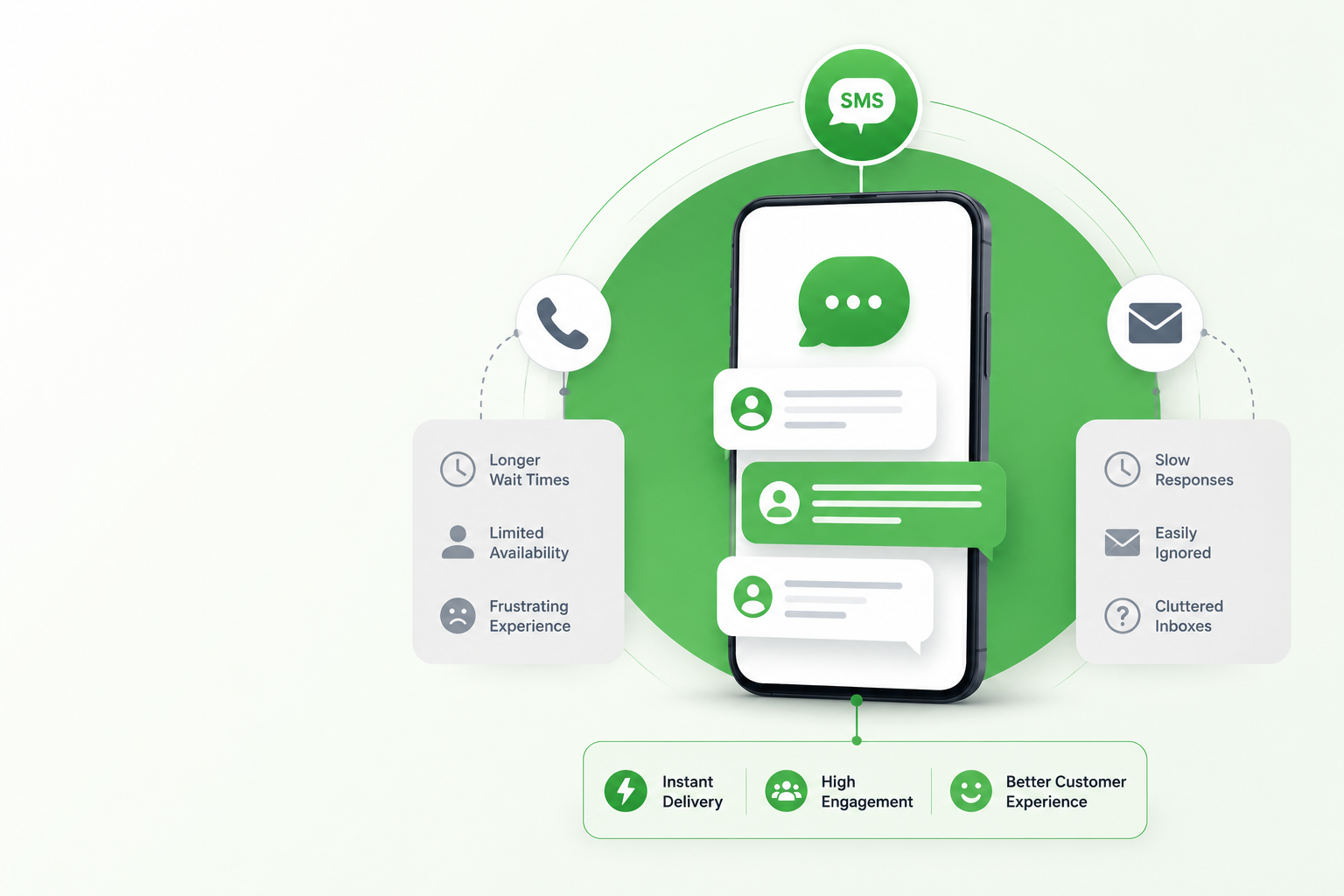
Judged on the attributes that decide whether a ticket closes today, the three channels separate cleanly. This is the core of the case for putting SMS ahead of email.
| Attribute | SMS | Phone | |
| Deliverability | Lands in the native inbox with no spam folder or promotions tab | Filtered by spam rules, tabs, and rules the customer set years ago | Connects only if the customer answers an unknown number |
| Reply loop | Minutes, because notifications are immediate | Half-day increments, since inboxes are worked in batches | Instant when answered, otherwise voicemail and a callback cycle |
| Thread continuity | One linear thread from first message to resolution | Fragments across reply-alls, forwards, and quoted history | No written record unless an agent logs the call |
| Customer effort | No login, no app, nothing to download | Requires opening a client, often with an attachment that fails on mobile | Requires being free to talk at that exact moment |
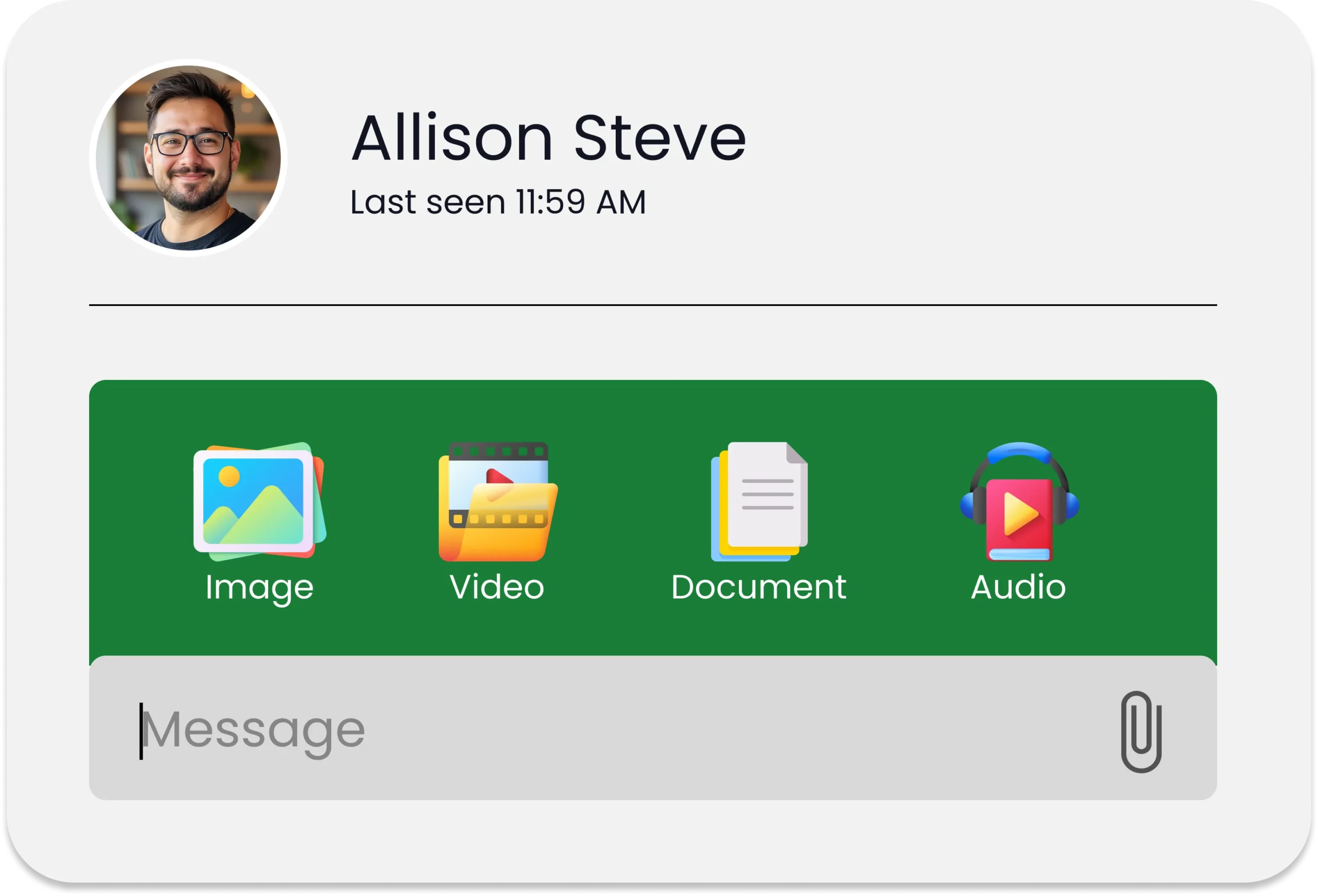
| Photos and documents | MMS carries images directly inside the thread | Attachments that frequently will not open on a phone | Not possible without switching channels |
The pattern is consistent. Email loses on speed, phone loses on record-keeping, and text is the only one of the three that holds both.

How SMS Customer Service Compares With Email and Phone
Judged on the attributes that decide whether a ticket closes today, the three channels separate cleanly. This is the core of the case for putting SMS ahead of email.
| SMS | Phone | ||
| Queue | None, asynchronous | Hold before answer | Batched, replies in hours |
| Agent capacity | Several at once | 1 at a time | Several, but slow loops |
| Thread history | Linear, searchable | Lost after call | Fragmented |
| Customer effort | No login or app | Must be free to talk | Client plus attachments |
| Photos and files | MMS inside the thread | Not possible | Attachments fail on mobile |
| Deliverability | Native inbox, no tabs | Only if they answer | Spam folders, tabs, filters |
The pattern is consistent. Email loses on speed, phone loses on record keeping, and text is the only one of the three that holds both.
Compliance Rules for SMS Customer Service
Support texting sits in a different consent tier from marketing. Conversational messaging, where the customer initiates and you reply, carries the lightest requirements. Informational messaging, where you send something the customer already asked for such as an order update or appointment reminder, needs express consent. Promotional messaging, where the text carries an offer or any sales content, needs express written permission. What matters is not drifting between them: a support thread is not a license to send an offer. Getting opt-in scope right at capture defines what you may send later.
How SendHub Runs SMS Customer Service
- SendHub Inbox gives the whole team one view of every customer thread and call
- Two-way texting so replies reach a person rather than an unmonitored number
- Text keywords that route common queries and handle STOP automatically
- Templates for consistent answers to the questions that repeat daily
- MMS and attachments so customers can send photos of the actual problem
- Merge fields to pull order, appointment, and account details into replies
- Contact database holding conversation history and consent records per contact
- Analytics and reporting to track reply times and volume by team
Get Started
Text wins the queue-free, repeatable, high-volume half of support. Keep the phone for complexity and email for documentation. Book a demo with SendHub to see how a shared inbox handles support texting at team scale.
Frequently Asked Questions
It is handling support conversations by text rather than voice or email. Typically, customers initiate, and an agent replies from a shared inbox.
Usually, because one agent handles several threads at once. However, savings depend on ticket complexity rather than channel alone.
For inbound conversations they initiate, consent is implied. Nevertheless, sending anything promotional requires express written permission.
Yes, through MMS. Consequently, warranty, damage, and installation queries can be resolved without a site visit.
Account numbers, health details, and identity documents. Instead, move those exchanges to a secure channel.
Within a published response window. Generally, a stated standard matters more to customers than raw speed.
No. Rather, it absorbs simple and repeat queries so agents have time for the calls that need them.
Partly. While routing, acknowledgements, and status updates automate well, resolution usually still needs a person.
Yes. Because carriers filter unregistered traffic, customer care should be declared as a use case.
Track first reply time, resolution time, and thread volume per agent. Then compare against your own baseline.